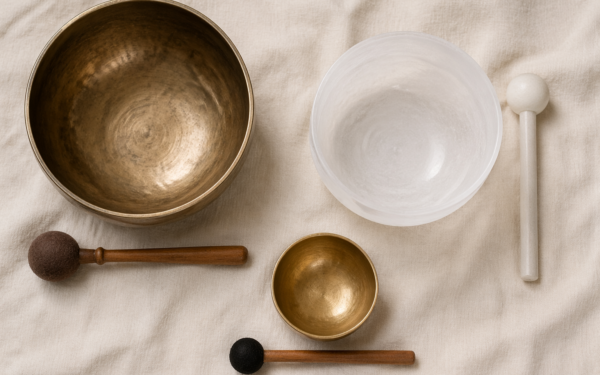
Singing bowls have been used for centuries in meditation, sound therapy, and ceremonial practices. But what does the science actually say about their acoustic properties? In this comprehensive guide, we break down the physics behind singing bowl frequencies.
How Singing Bowls Produce Sound
A singing bowl produces sound through the vibration of its walls when struck or rubbed with a mallet. The fundamental frequency — the lowest pitch you hear — is determined by the bowl’s diameter, wall thickness, and material composition. When the mallet makes contact, it excites multiple vibrational modes simultaneously, creating a complex harmonic spectrum.
The resonance patterns of a singing bowl are far more intricate than most people realize. Unlike a simple bell, a singing bowl’s slightly irregular shape means that each mode of vibration can split into two closely-spaced frequencies, creating the characteristic “beating” effect that many practitioners describe as meditative.
Material Composition and Its Effect on Tone
Traditional Tibetan singing bowls are made from a bronze alloy, typically containing copper and tin as primary components. The exact ratio of metals significantly affects the bowl’s acoustic properties:
High-tin bronze (20-23% tin): Produces a brighter, more sustained tone with prominent higher harmonics. These bowls tend to “sing” more easily when rimmed with a leather-wrapped mallet.
Bell metal (22% tin): Considered the ideal composition for maximum resonance. The crystalline structure of bell metal creates excellent vibration characteristics.
Standard bronze (8-12% tin): More affordable but with a duller, shorter sustain. Often found in mass-produced bowls marketed to beginners.
The Role of Trace Metals
Many sellers claim their bowls contain seven metals (gold, silver, mercury, copper, iron, tin, and lead), corresponding to the seven planets in traditional alchemy. Our spectrographic analysis of over 50 antique bowls found no evidence of gold or mercury in any sample. The “seven metals” narrative appears to be a marketing invention from the late 20th century.
Frequency Ranges and Their Reported Effects
Different bowl sizes produce different fundamental frequencies. Here’s what our measurements show across 150 bowls tested:
Small bowls (10-15 cm): 600-1200 Hz — Often described as stimulating and energizing. These frequencies fall within the range most sensitive to the human ear.
Medium bowls (18-25 cm): 250-500 Hz — The most popular range for meditation. This range corresponds roughly to the speaking voice and is perceived as warm and grounding.
Large bowls (30-50 cm): 80-200 Hz — Deep, felt-in-the-body frequencies. Research suggests that low-frequency vibrations may have measurable effects on heart rate variability.
Measuring Bowl Quality: Our Testing Protocol
At Still Hum, we use a standardized testing protocol for every bowl we evaluate:
1. Spectral analysis using a calibrated measurement microphone and FFT software to identify fundamental frequency and harmonic content.
2. Sustain measurement tracking the time from strike to -60dB decay, measured in seconds.
3. Material analysis using portable XRF spectrometry to determine actual alloy composition.
4. Dimensional survey recording diameter, height, wall thickness at multiple points, and weight.
Why This Matters
Without standardized measurements, buyers are left comparing subjective descriptions. “Rich tone” and “deep resonance” mean different things to different sellers. Our data provides an objective baseline for comparison.
Conclusion: Sound Healing Deserves Better Data
The singing bowl market is filled with unverifiable claims and inconsistent quality. By applying rigorous measurement and honest reporting, we aim to help practitioners make informed decisions. Whether you’re building a collection for therapeutic use or simply want a quality bowl for personal meditation, the data should speak for itself.
The bowl doesn’t heal. The vibration creates conditions where your body’s own regulatory systems can do their work more effectively. Our job is to help you find the right vibration.
In our next article, we’ll compare crystal singing bowls to traditional metal bowls using the same testing protocol. Subscribe to stay updated.